About to start blogging again, because I'm heading for Tijuana, with Al Otro Lado Border Rights Project, and I want to be sure I can describe what I see.
Stand by. Coming your way early March.
Thursday, February 21, 2019

Sunday, January 15, 2017
Doors Open / Doors Close
My show Doors Open / Doors Close is currently up at Ceres Gallery, through January 28, 547 W. 27th, 2nd floor. Tuesday-Saturday noon-6, Thursdays noon-8.
Lines: my favorite formal element.
Doors: my current favorite thematic element.
And then you are inside.
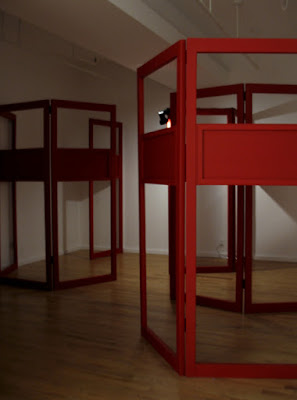
I've built Doors Open / Doors Close with door frames that have open panels, so that there are visible lines, and changing shapes with the movement of the viewer. On the outside, a stark maze of doors, both sheltering and exposing, and like all shelters, you don't know who is inside.
Inside this shelter, collages and poems by women who live in domestic violence shelters, expressing every emotion: grief, trauma, anger, and hope. These women have fled their homes leaving everything behind in search of safety for themselves and their children.
Doors Open/Doors Close, partial outside view


Saturday, June 11, 2016
Trees
I went up in a crew of 5 from the Society for the
Advancement of Judaism (SAJ), to maintain our trail in the Wawayanda State
Forest, NJ. We went to thwack away the
brambles leaning over the trail, that catch you with giant spikey thorns if you
don’t watch out. I go, too, because
trees are for me the most perfect art form, sculpture and dance, even when
perfectly still, and always musical in the wind. The beavers have done their own carving, in
their ever-growing pond, now a lake, now a watery village with a number of
lodges and one high-domed civic center, of sorts. And
many many peeled, leafless, sculpted, chewed, isolated, dying, drowned
remarkably shaped remnants of tree trunks.
It rained a lot, all the more beauty. The beaver pond sat under a thick mist, and
all the tree bark was wet, highlighting the shapes of the stumps. The wet rocks on the trail were treacherous
and slippery, but that also intensified their colors.

Carvings

The civic center

A little more and over it goes

A mysterious group
I’ve gone a few times before: one blog Two Ladders is about a natural formation I found there and a companion piece made by an
artist, Judy Hoffman. Another is about
painting the blazes An Artist's
Art.
Monday, May 30, 2016
Colors and Cataracts
Many artists
(and others) around my age are discussing cataract surgery, and they either marvel or rue the marked
change in the perception of color.
I have a
preference for a soft yellow-leaning palette and all my drawings and oil
pastels were done accordingly. Orangy-red
instead of alizarin crimson. I reveled
in that warm dreamy range of color. It
made me very happy. I saw the world
itself in that palette.
Cataract
surgery on my left eye two years ago: no,
this isn’t possible. Is that what
everyone sees, a cool neutered white? (Some artists reported a sudden new brilliant white). My
entire body of work, not to mention every environment I inhabit, was suddenly
not what I thought it was. Cooler.
My dominant
right eye, as yet unfixed, still sees what I always saw. To draw in color now I have to close that eye to create
on the paper what I think most uncataracted people see, to get the warm
color I want. I can’t go back and change
the color of my finished work. I can
only go forward, closing my right eye frequently to perceive what must be the
common visual reality.
Everywhere
else, with both eyes open, I see a mix, not so warm, not so cool. For this reason alone, I’ll hang onto that
little cloud in my right eye until it really has to go, and I wink one way
and then the other, to get the whole story.
It's something like this, but of course I also have no control over what you see on your screen, we all see something different, and double that for alternating winks. But to try to clarify:


Thursday, April 21, 2016
Keeping a Journal
I had a brief flirtation with normalcy yesterday, home after a
very hard month by the bedside of my ill sister in Israel, and yet I felt very
alone. Today I realize why that
was. I didn’t talk to myself all day, at
least not in hearing distance. Why was that? Mad at myself for something, probably.
But I did finish another Journal
Entry. So very fitting, these works
in which I write my thoughts and then write more on top of the first, until
nothing is legible, no matter the language, which in this case is Yiddish. Very few people have so far signed onto this blog, a
handful, and that too is fitting, since I spend a lot of effort obscuring my
messages in my work. So I see this blog
as one of my works. (but please do sign on).
The text is the bottom object in the stack of three. I also like stacks of things, a little edgy, not quite
balanced.
Journal Entry 8, pencil on photo litho, image 16"x11", 2016

Monday, October 5, 2015
Post-installation collaboration, Saunder’s Farm, Garrison, NY
We don’t usually expect that a sculpture will change after the
installation. But things are different out on the farm. There are those
who scratch their backs on our work, and who like the crunch of fallen trampled
parts, and the taste of print and cardboard.


 Signed.
What I installed:

Shelter, A Book of Doors, featured in my previous post
They who scratched their backs and trampled and nibbled, after finishing their main course:

The collaboration, with new meanings, perhaps.
The spine of the book is now quite visible.
The tasty door-pulls have been replaced: cardboard and text.
Yes, they ate words.
The spine of the book is now quite visible.
The tasty door-pulls have been replaced: cardboard and text.
Yes, they ate words.


Friday, September 18, 2015
Shelter, A Book of Doors
I've been volunteering at Holy Apostles Soup Kitchen, giving collage workshops. I got the idea of collages from participating in Carla Rae Johnson's Alternet, for which I made many many tiny collages. HASK serves 1200 lunches a day, but people can come for seconds, so maybe it's 800 people daily, and we try to entice them up to the monthly-soon-to-be-weekly workshops. A few come. One woman who comes regularly is an active artist. One man who comes loves to draw, is an artist too. Others are curious beginners. I also mentor at the Interfaith Assembly for Homelessness and Housing, in a one-on-one program called Panim al Panim (face to face).
So the obvious next step for me is to put together my art practice with what I learn from HASK and IAHH, and with my current obsessions - doors, and always shelters, always some kind of room, since the beginning of my sculpture making. With open walls, they are spaces that are both defining and liberating.
This year I built Shelter, A Book of Doors for the Farm Project 2015, of Collaborative Concepts, in Garrison, NY.

The "book covers" are hollow core doors. The "pages/doors" are built and have missing panels, and door-pulls made of cardboard, the iconic material of homelessness, or our idea of it. The "spine" is supported inside with ribs of tossed-off bent bicycle wheels. My idea is that shelter for me might be reading a good book in a quiet corner somewhere, and out of the corner of my eye I acknowledge that someone else has an entirely different idea of that word, shelter. The door pulls are covered in text and photos removed (gulp) from books.

In the coming year, I hope to exhibit a large sculpture that displays the collages being made at Holy Apostles.
So the obvious next step for me is to put together my art practice with what I learn from HASK and IAHH, and with my current obsessions - doors, and always shelters, always some kind of room, since the beginning of my sculpture making. With open walls, they are spaces that are both defining and liberating.
This year I built Shelter, A Book of Doors for the Farm Project 2015, of Collaborative Concepts, in Garrison, NY.

Shelter, A Book of Doors, painted wood, cardboard,
book pages, bicycle wheels, 7' x 7' x 5'
The "book covers" are hollow core doors. The "pages/doors" are built and have missing panels, and door-pulls made of cardboard, the iconic material of homelessness, or our idea of it. The "spine" is supported inside with ribs of tossed-off bent bicycle wheels. My idea is that shelter for me might be reading a good book in a quiet corner somewhere, and out of the corner of my eye I acknowledge that someone else has an entirely different idea of that word, shelter. The door pulls are covered in text and photos removed (gulp) from books.

In the coming year, I hope to exhibit a large sculpture that displays the collages being made at Holy Apostles.
Monday, July 20, 2015
A fortune in doors
I recently wrote a short essay for a memoir writing class
that was really about feminism and my relationship with my mother. But in it I mentioned doors in almost every
paragraph. She stood in the doorway of
my bedroom watching me, pre-kindergarten, play with my dollhouse, and I stood in
her doorway watching her ironing, and subsequent doors. But the interesting
part is that doors are now a significant part of the art I make in
three-dimensions. Last year for the
Collaborative Concepts show in Garrison, NY, my work had three doors in an
otherwise open frame. This year my work
in that show will be made entirely of doorframes, but with doorknobs (somehow, haven't figured it out yet). And this is a model I built for a proposal, “Home”,
yes, this is a model, 8” high, shot lying flat on my stomach in Sakura Park.

Tuesday, January 20, 2015
Staten Island the Sneaker
We all know that Italy looks like a boot, a very high over the knee boot, and Oh, poor Sicily.

But have you looked closely at Staten Island? On the New York City subway map, it's quite clear.
Staten Island the Sneaker. All it needed was laces.

Sunday, November 16, 2014
By Invitation Only, Please Knock Before Entering
This is my sculpture that now appears in "Brains, Boobs, and Backbones", at the Paramount Theater in Peekskill, NY. It has "My Uterus" prefixed to its name for this show. It originally was shown in "Meet my Uterus", at Ceres Gallery, NYC, so it didn't need that prefix then, and I posted it in this blog, Feb 9, 2013. At the time, people such as Todd Akin had announced that if a woman gets pregnant, it wasn't a legitimate rape, because "the whole thing shuts down." Newspaper clippings are included in this piece, which is made predominately of cardboard, with ears and eyes (of Fimo) on constant watch. It was reviewed in The New York Art World, Spring 2013.
Besides the message, I'm really attracted to stacked laminated cardboard because of the light that passes through the ribs. Wonderful material.

Besides the message, I'm really attracted to stacked laminated cardboard because of the light that passes through the ribs. Wonderful material.
Saturday, November 1, 2014
Yom Kippur
In the synagogue, there is a long silent
meditation called the Amidah. There is text, so it's more a prayer than a
meditation, and sometimes it's chanted, everyone together, out
loud. But there is also a silent Amidah, and we are
instructed to read what's given or to meditate or to contemplate what's in our own hearts. We stand until we're done, and one by one, we sit.
On Yom Kippur, 2014, the synagogue was full, sanctuary and balcony. The Amidah began, everyone on our feet and after a while people started to close their books and sit down. One man in the front row was immersed in his prayer, maybe reading both the Hebrew and the English, maybe adding the alternative readings, while all around him, everyone else finished and sat down. The rabbi and the cantor sat down. It is the custom to wait for everyone to finish so we waited, and the respect and patience shown the man who continued praying said more about the community than anything else.
The room was silent. No one coughed or whispered. The standing man continued thoroughly absorbed in his reading. After a while, the man sitting next to him looked at the rabbi, who I couldn't see from where I sat in the balcony, and whispered something to the praying man, who didn't hear it, and who continued reading on his feet. Thirty more seconds passed, and the rabbi and cantor got to their feet to resume the service. The sitting man gently tugged on the sleeve of the standing man, who then looked around and sat down.
In the interlude of this man's solitary praying I experienced a deep stillness and peacefulness that more than anything was the essence of being in a spiritual moment.
On Yom Kippur, 2014, the synagogue was full, sanctuary and balcony. The Amidah began, everyone on our feet and after a while people started to close their books and sit down. One man in the front row was immersed in his prayer, maybe reading both the Hebrew and the English, maybe adding the alternative readings, while all around him, everyone else finished and sat down. The rabbi and the cantor sat down. It is the custom to wait for everyone to finish so we waited, and the respect and patience shown the man who continued praying said more about the community than anything else.
The room was silent. No one coughed or whispered. The standing man continued thoroughly absorbed in his reading. After a while, the man sitting next to him looked at the rabbi, who I couldn't see from where I sat in the balcony, and whispered something to the praying man, who didn't hear it, and who continued reading on his feet. Thirty more seconds passed, and the rabbi and cantor got to their feet to resume the service. The sitting man gently tugged on the sleeve of the standing man, who then looked around and sat down.
In the interlude of this man's solitary praying I experienced a deep stillness and peacefulness that more than anything was the essence of being in a spiritual moment.
Wednesday, September 24, 2014
Art in the Archives, traveling show, just left City College, NY, off to Teaneck, NJ
i've got a whole drawer, 300 tiny works, collages, paintings, journal entries, jokes.

My drawer photo Elizabeth Knott
The show is soon to be in Teaneck, NY. Check back for details.
Wednesday, September 3, 2014
There Once Was a Gazebo


Conceived as “A Gazebo”, this work was hopeful about the possibility of peace in the West Bank. But during its development, the entire Middle East met calamity after catastrophe, and the piece changed accordingly. I could no longer festoon its surfaces with colorful Palestinian and Israeli cultural icons. It's still a quiet piece, because I am still a minimalist, that is, making my point with the least amount of structural material, but I'm hoping it causes people to reflect, to be moved, and to ask - what does she mean by that?, as I have been moved to ask myself.
I hoped
that by calling it "There Once Was a Gazebo", people would know
I meant there was a peaceful place and now there isn't, and I hoped that the
two newspaper photos in the piece would convey that I am now talking about Gaza
without telling people what to think. But not everyone is as obsessed
with that part of the world as I am, so if people don't get the narrative, I
think the aesthetic solution stands on its own, a very important aspect of all
my work – room-like, lines, shadows.
Subscribe to:
Posts (Atom)